How does a world in continuous change give rise to order,
life and understanding?
A book and a research programme explore this question across philosophy,
mathematics, physics and computation. The book develops a multi-level account
of reality and knowledge; the papers pursue explicit generating constructions
and the relations they preserve.
An exploration of how order, life, consciousness, society and
meaning emerge from a world in constant change.
Drawing on physics, biology, neuroscience, complexity science, and Eastern
and Western philosophy, the book develops a way of understanding reality
across its different levels. Entropy, symmetry, emergence and self-organization
become connected questions about how structures form and endure.
Its central concern is methodological: how to move beyond apparent paths,
return to facts and processes, and discover the relations through which the
world becomes intelligible. This perspective gives the collection its
philosophical and methodological setting.
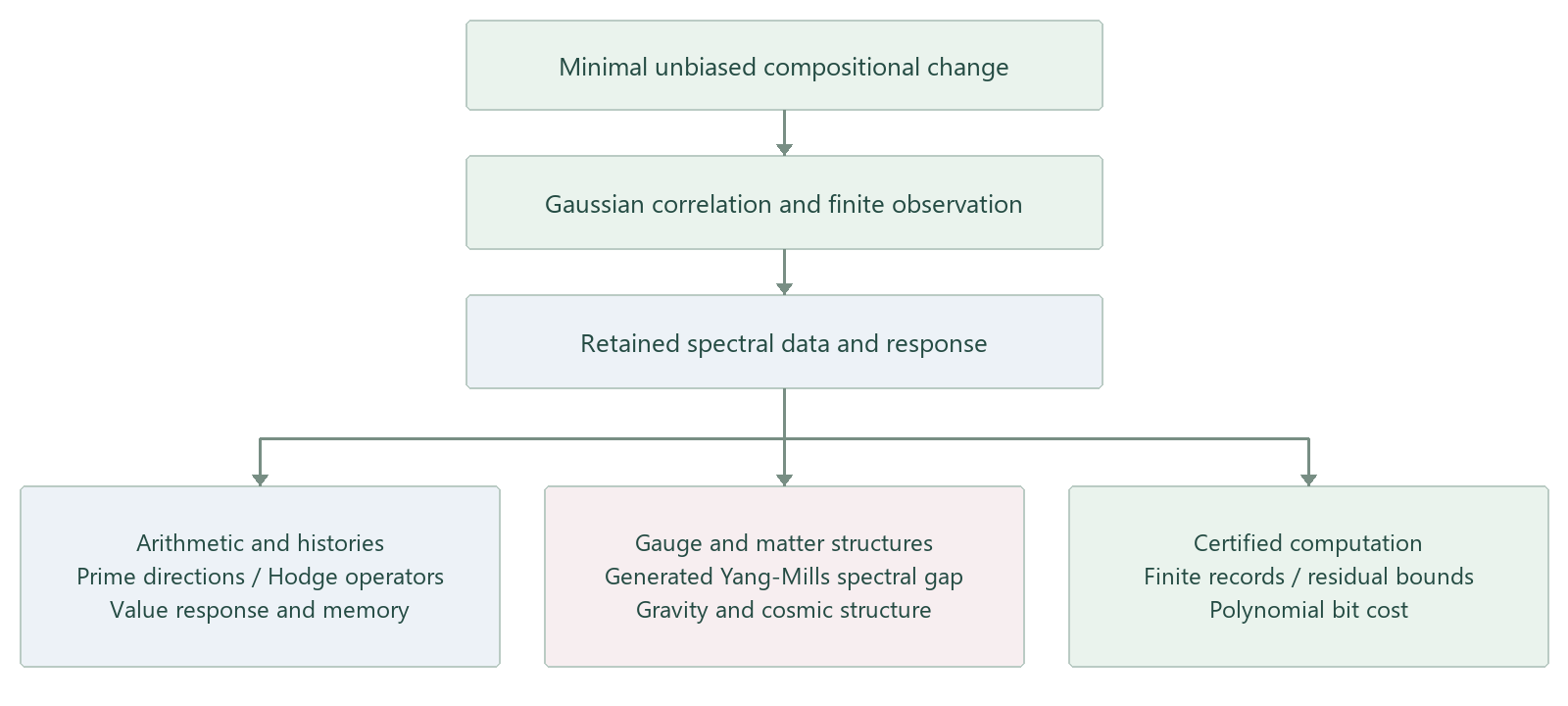
The research programme begins with minimal unbiased compositional change.
A common generating source connects arithmetic histories, compact gauge
structure, long-range response and finite certified computation. Its results
include a history-dependent natural-number system, quantitative prime projectors,
a generated Yang-Mills spectral-gap theorem, and polynomial-cost trajectory
certificates.
The branches share generating data. Their theorems specify the maps,
realizations and response classes connecting one stage to the next.
Full-resolution diagram.
For the broader ideas, begin with Beyond Apparent Paths.
For a mathematical construction, physical mechanism or verification record,
follow one of the routes below.
Mathematical construction
Begin with natural-number arithmetic,
then prime decomposition and generated spectra. Expression histories connect
arithmetic values to later response and memory.
Physical response
Read Compact Internal Space I and II, then
the gravity criterion and coarse-graining. The third compact-space paper develops
finite-window cosmic structure.
Formal and numerical evidence
The Lean library gives declarations
and theorem-to-paper mappings. V5 gives executable source records, interval
certificates and observational comparisons.
We construct natural-number arithmetic on an ordered family of correlation modes and retain the expressions by which its elements are generated. Minimal unbiased compositional change determines a rotation plane and a...
Construction of natural numbers · Arithmetic expression trees · Conditional expectation · Trace-class operators · Non-Markovian dynamics · Memory kernels
We construct decomposition and occupation operators on a generated correlation-spectral arithmetic system. Prime residue classes form the augmentation cotangent basis, and the corresponding one-word vectors span the...
Prime factorization · Hodge Laplacian · Prime projection · Möbius function · Riemann zeta function · Fock space
Nonlinear spectral evolution requires control of the frequencies present initially and those created by interaction. We study how spectral bounds can be retained with the construction of a state and reused in later...
We study finite records whose accuracy for an infinite-dimensional nonlinear evolution can be checked without rerunning the producing algorithm. The model is a fixed Neumann reaction–diffusion equation with quadratic...
From minimal unbiased compositional change we construct compact internal geometry and gauge–matter representations, and prove a mass gap for the generated Yang–Mills response. On the least-dimensional nontrivial compact...
Standard Model gauge group · Chiral fermions · Higgs doublet · Yang–Mills mass gap · Spectral geometry · Vacuum stability
Minimal unbiased compositional change generates the Gaussian source of the compact internal construction. We derive joint constraints on effective couplings and mass scales from its gauge and matter content, scalar...
Three fermion generations · Fermion mass hierarchies · Fermion mass relations · Gauge coupling constants · Higgs boson mass · Neutrino masses
We give a source-resolved spectral criterion for long-range tensor exchange between conserved matter sources. Exact channel elimination preserves the propagation kernel together with the source and readout maps and the...
We study when a reduced description preserves the response to an applied source. For systems defined by continuously differentiable state updates and observations a bounded surjective linear coarse map gives...
Coarse-graining · Model reduction · Linear response theory · Pole stability · Spectral residues · Memory kernels
Cosmic matter forms concentrations whose external force can often be described by their mass and spatial moments. Encounters and material exchange can make finer structure relevant again. We determine when field and...