Generated Gauge Structure and the Yang-Mills Spectral Gap
The physical construction follows a common source into compact internal geometry, response algebras, matter representations and a nonlinear field action. Keeping these stages connected allows the same source quantities to enter both structural theorems and numerical readouts.
Geometry, gauge structure and matter
The Gaussian correlation construction supplies local and global correlation lengths and a reflected spectrum. In the stated compact representation and response classes, the continuation selects the projective internal carrier, the gauge quotient (SU(3) x SU(2) x U(1))/Z6, a sixteen-dimensional complex matter bundle and a scalar weak doublet. The papers state the comparison classes in which the corresponding selection and uniqueness results hold.
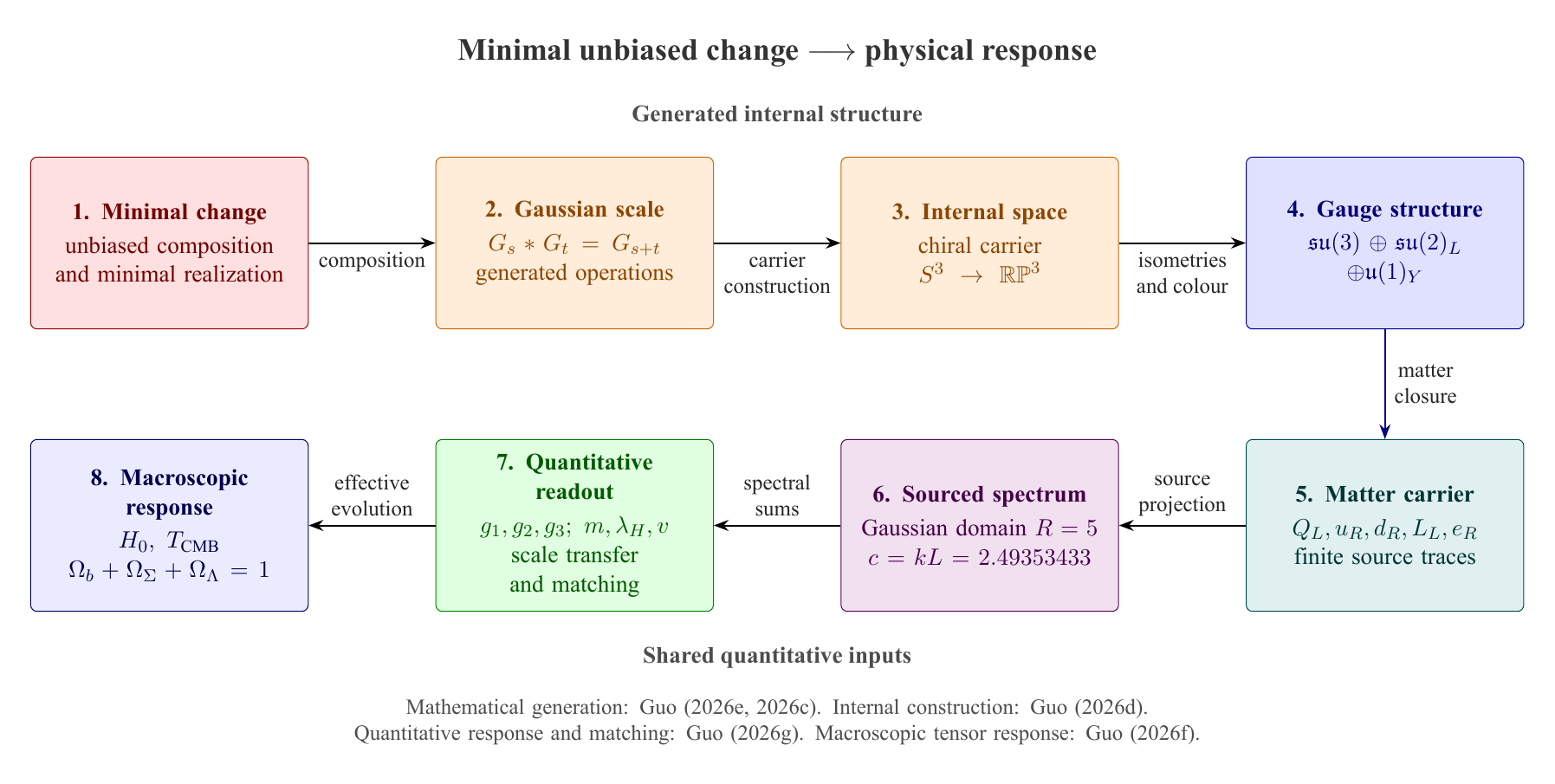
The upper row follows the structural construction; the lower row follows the shared quantitative inputs into effective and macroscopic response. Open the vector diagram.
A nonlinear action and its complete Hessian
The generated Yang-Mills construction evaluates an actual curvature-trace action on the original Haar one-form fields. Differentiating it gives the radial response and the coexact connection block, with zero mixed second derivative. The weak divergence kernel has a complete source-derived basis. The original-field differential Hessian has a unique self-adjoint closure, an explicit weighted-square domain and an attained positive spectral bottom. Finite occupation then yields the associated Fock gap.
The Lean entry CanonicalYangMills.generated assembles the source-generated
IR-edge model. Its radius is the Gaussian IR edge. The separate
CanonicalYangMillsTT.generated uses a transverse-traceless endpoint
certificate. These two radius realizations have distinct formal interfaces
and numerical calibrations.
Couplings and mass scales from a common response
V5 evaluates the finite spectral response and certifies its selected level and endpoint. At the selected level R=5, an exact eight-branch reduction determines a unique transverse-traceless endpoint near 2.49353433. The same generated record feeds gauge couplings, mass-scale relations, electroweak matching and cosmological readouts. Source-derived quantities, dimensional calibration and observational comparisons remain separately inspectable.
The mass-relation paper develops one charged-lepton relation in a geometric six-fermion setting. The numerical framework records which quantities are derived, which are reference inputs, and which errors belong to finite resolution or physical matching. A shared input can therefore be varied once and its correlated effect followed across several observables.
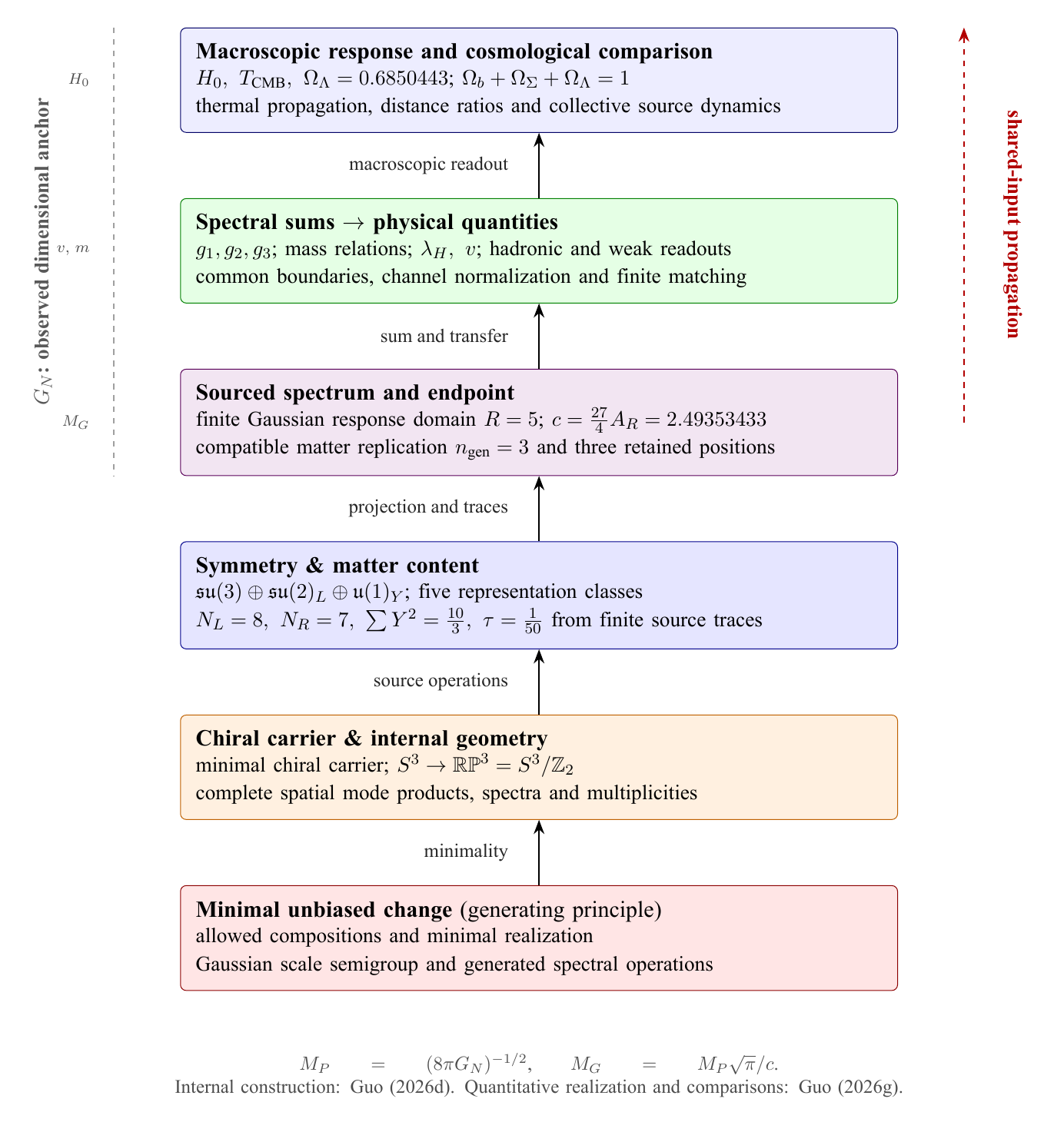
The layered view separates the common structural source, its finite response and physical readout. The observed Newton constant calibrates dimensions; shared spectral inputs propagate through the upper layers. Open the vector diagram.
Numerical results and tests
The common calculation selects three fermion generations and R=5. The paper's principal comparison table has 41 entries, and its observable-test table gives seven groups of measurements spanning neutrinos, primordial tensors, glueball spectroscopy and low-acceleration gravity.
| Quantity | Calculated result | Relative difference from the adopted reference |
|---|---|---|
| Strong coupling αₛ(MZ) | 0.118041 | +0.120% |
| Electroweak scale | 246.190 GeV | −0.012% |
| Z mass | 91.12484 GeV | −0.069% |
| Higgs mass, tree-level relation | 124.98344 GeV | −0.173% |
| Vacuum-density fraction | 0.685044 | +0.050% |
V5 supplies 57 named benchmark comparisons, including 56 central-value rows and one upper-limit test. Of the central-value rows, 51 have absolute relative differences below 1%. Alternative approximations, reciprocal ratios and geometric-mass diagnostics retain their separate rows and conventions. The full paper introduction gives further results and the reported discrepancies.
Read and reproduce
- Compact Internal Space I: Gauge Structure and a Scalar Mass Gap
- Compact Internal Space II: Effective Couplings and Mass Scales · arXiv:2607.24329 · DOI
- Lean theorem library
- V5 calculations and interval certificates
Keywords: Yang-Mills, mass gap, spectral gap, gauge theory, Standard Model, matter representations, Higgs doublet, compact internal geometry, Lean.
Research subjects and results
Primary subjects
Yang-Mills theory; Mass gap; Standard Model gauge group; Gauge symmetry; Chiral fermions; Higgs doublet; Spectral geometry; Quantum field theory; Matter representations; Spectral gap; Vacuum stability; Mathematical physics; Fermion generations; Three fermion generations; Fermion mass hierarchies; Fermion mass relations; Gauge coupling constants; Standard Model parameters; Electroweak symmetry breaking; Higgs boson; Particle cosmology; One-loop matching; Charged lepton masses.
Methods
Representation theory; Lie groups; Gaussian measures; Self-adjoint operators; Quadratic forms; Coercivity estimates; Spectral analysis; Hodge decomposition; Fock space; Osterwalder-Schrader reconstruction; Reflection positivity; Causal perturbation theory; Source covariance; Equilibrium analysis; Formalized mathematics; Canonical normalization; Effective couplings; Renormalization schemes; Finite matching; Perturbative quantum field theory; One-loop calculations; Self-energy calculations; Spectral transfer; Parameter elimination; Nonlinear elliptic equations; Weak solutions; Cosmological parameter estimation; Numerical quadrature; Spectral tail bounds.
Results and research questions
Derivation of the Standard Model gauge group; Classification of chiral matter representations; Selection of a complex Higgs doublet; Positive mass gap for the generated Yang-Mills operator; Unique vacuum and attained spectral gap; Complete coercivity of the Yang-Mills Hessian; Lorentzian geometry from a phase clock; Interacting gauge-matter fields by causal perturbation theory; Selection of three fermion generations; Geometric relation among six fermion masses; Correlated electron and electroweak mass scales; Unique transverse-traceless spectral endpoint; Gauge and Higgs matching from a common action; Born-level top quark decay width; Cosmological ratios independent of neutrino mass normalization; Nonlinear gravitational flux from source covariance.
Chinese subject terms
杨米尔斯理论; 质量间隙; 标准模型规范群; 手征费米子; 物质表示; 希格斯双重态; 真空稳定性; 谱几何; 紧致内部空间; 洛伦兹几何; 自伴算子; 量子场论; 三代费米子; 费米子质量层级; 六费米子质量关系; 规范耦合常数; 标准模型参数; 带电轻子质量; 电弱对称性破缺; 一圈匹配; 希格斯质量; 顶夸克衰变; 粒子宇宙学; 真空能.